What is the value of PR?
It is a question that is often asked but rarely well answered. Some intuitively understand that a strong brand reputation is good for business, others are more sceptical about the impact it makes on the bottom line.
A challenge for the PR profession as a whole is that we are often pigeon-holed into measuring media coverage volume, social media engagement, or website hits. But what we need to be measuring to show our true value is leads, sales, and ultimately business impact. Often, this is easier said than done. But it is possible.
I stumbled across this study recently by management consultancy Ocean Tomo that shows what makes up the underlying value of business today. Looking at the S&P 500, the research shows a fundamental change has happened over recent decades to what drives business valuation.
“In 1975, tangible assets – property, plant, equipment, inventory, and other physical capital – represented 83% of the market value of companies comprising the S&P 500 index, with intangible assets accounting for only 17%,” the research said.
“By the end of 2025, this relationship had completely inverted: intangible assets now constitute approximately 92% of S&P 500 market capitalisation, while tangible assets have been reduced to a mere 8%.”
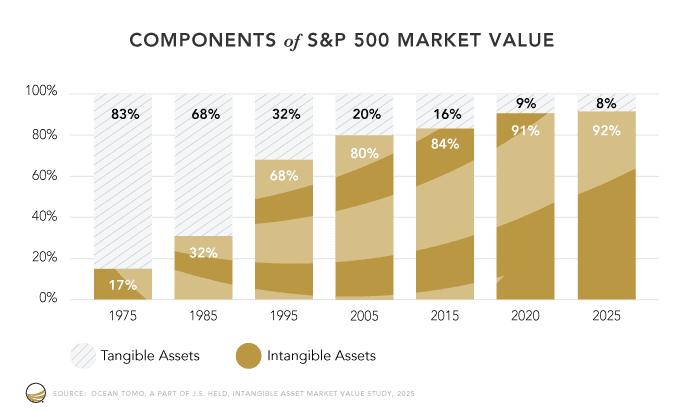
So, for everything a business owns, it is actually the non-tangible assets that matter most. And reputation is one of the most important intangible assets you can invest in.
Burson recently estimated the “Reputation Economy” to be worth over $7 billion globally and that a strong reputation can deliver 4.78% in additional unexpected annual shareholder returns. That is serious alpha.
At its core, reputation is how your stakeholders – government, clients, customers, members, staff – perceive your brand. You can certainly influence your reputation, but you can’t control it.
Reptrak details seven drivers of reputation: Product & Services; Innovation; Workplace; Conduct (being ethical); Citizenship (ESG); Leadership; and Performance.
Communications can influence all these drivers – providing strategic insight into what your stakeholders think, advising on new initiatives, and better showcasing the work your organisation is doing.
Across our clients, we see the role PR can play in helping to build, and protect, brand reputation. But the research highlights the true value of PR in a way that is easily understood by everyone in the business. So, when it comes to the business balance sheet, remember trust and reputation are the most invaluable intangibles your business can invest in.